I'm down to one hand’s worth of days in my countdown! The nerves and excitement are building. I still need to compile everything into my bags, and make sure that it's going to fit the weight requirements. When I first get to Brazil, and before orientation begins, I'm traveling to Ilhabela for some sights, beaches, and hiking. I also am so grateful to be adventuring with a fellow Fulbrighter, who has better Portuguese skills, and explore a beautiful island. Evidently Sao Paulo is consistently a rainy state, which is probably equivalent to the humid rainy showers in Florida, but I'm hoping there will be sunshine for my week there.
So far, I've said goodbye to everyone except for my mother and step dad. One of the worst parts about leaving long term to go abroad, other than missing the food, is leaving your family. It was so hard to hug them and say goodbye, especially knowing that I won't be home for the next major holiday. Like I said- it's a mix of nervousness for leaving what I know and excitement to experience something new.
Lastly, I want to give a huge shout out to someone who has major this experience less scary- Mario. I think I only met you once when we studied together in New Zealand, but I'm so incredibly grateful to have met you and that you've been helping me. Between Skype sessions practicing my Portuguese and assisting me to find an apartment, I appreciate all of the time and kindness that you have shown me. I can't wait to be your neighbor down the street!
Here come the last minute planning sessions for my pre-orientation travels!
Sunday, February 18, 2018

Sunday, February 11, 2018
Spanish and Portuguese Are Basically the Same Right? Wrong.
I hate to admit it, but I got sucked into the lull of a false sense of security with learning Portuguese. I told myself- Britt, you know Spanish, so this should be easy. WRONG. Portuguese and Spanish are very similar in structure, and a lot of the words are similar, but I forgot that it’s also a completely different language. Some phrases look alike, but the pronunciation varies greatly. For example, in Portuguese the letter “r” can be pronounced as a “h” and “d” as a “j”. Also, Portuguese, so me, seems like a mix of French and Spanish. Maybe one day it will make learning French easier.
Seeing as I first applied to a Fulbright in Spain, a Spanish speaking country, I did not plan at first to be teaching in a Portuguese speaking country. It wasn’t until September that I found out I won the Fulbright Fellowship for Brazil, and then started practicing. I fumbled around with Duolingo, which is helpful that it gives the lessons in small chunks that are categorized. I honestly did not practice as much as I should have, and only realized in January that many library systems offer Rosetta Stone for free. Since then, I have been utilizing both programs, but I’m frustrated that both programs still focus on phrases like “she is cooking” and “This is my mom”. I’m probably going to look up some crucial travel phrases before I head out. 11 days of cramming Portuguese to go!
Seeing as I first applied to a Fulbright in Spain, a Spanish speaking country, I did not plan at first to be teaching in a Portuguese speaking country. It wasn’t until September that I found out I won the Fulbright Fellowship for Brazil, and then started practicing. I fumbled around with Duolingo, which is helpful that it gives the lessons in small chunks that are categorized. I honestly did not practice as much as I should have, and only realized in January that many library systems offer Rosetta Stone for free. Since then, I have been utilizing both programs, but I’m frustrated that both programs still focus on phrases like “she is cooking” and “This is my mom”. I’m probably going to look up some crucial travel phrases before I head out. 11 days of cramming Portuguese to go!
Wednesday, February 7, 2018
Lessons Learned- vaccines aren't cheap and apartments can be hard to find
First off, vaccines can be very expensive! My program suggested that I get the Hepatitis A, Typhoid, and Yellow Fever vaccines, and I finally got the last of the bunch. I searched all through the CDC website suggestions, but only found that Passport Health travel agency had the Yellow Fever vaccine. I was so excited to get the yellow WHO card!
Searching for the “right” apartment was a journey! I wanted to find somewhere close to the center city, in a safer neighborhood, and with apartment-mates close to my age. My host professor suggested a few apartment ideas, and I reached out to an undergraduate she had listed to possibly having housing. With luck, the student is so incredibly nice, and also an English major! There are two other apartment-mates, who are a little bit older, but also seem like they will be nice. The apartment is between the large city lake and the city center, which makes it very easy to go for a run around the lake or take a bus into the city.
Things are shaping up, and there are just a few more things on my list that I need to do in the last week. For example, I can’t get my long term medicine prescriptions until the week before and I need to call my banks to let them know I’ll be abroad. I made the mistakes of not notifying my banks when I went to Fiji two years ago, and lesson was learned!
Saturday, February 3, 2018
On the Brink of a Packing Frenzy
Do you ever have those moments when something finally clicks? It makes you stop, physically stop what you’re doing, and take a minute to let it soak in. Three more weekends in the USA for a while, including this weekend. Nineteen days and counting! I wish that I could say my Portuguese is better at this point, but Rosetta Stone still has me on phrases like- o gato e preto and os meninos sao cozinhando (the cat is black and the boys are cooking). It’s a work in progress, but I’ve been working on it everyday.
This past week kick started my packing frenzy! While in New York City, visiting Columbia University, I picked up some souvenirs to give as gifts. Then yesterday I went a bit crazy. As ironic as it is, The Christmas Tree Shop is open all year with a little bit of everything on sale, and it had a great clearance sale. I went in with the intentions of getting some stationary to bring, but instead I walked out with holiday themed items to use as teaching materials and a few small gifts. To say the least, I nerded out and laid out all of the stuff I bought when I got home. Yesterday was filled with packing lists, inquiries for opening a bank account, and organizing materials.
Interesting fact- Brazil also has HSBC, Citibank, and Santander banks, BUT when I talked to Santander they reported that the USA branch is separate from the Brazilian system. This means opening a bank account in the USA would results in foreign transaction fees everytime I used that bank card in Brazil. Tip- if you’re going abroad then definitely check into bank affiliations that limit or prevent foreign transactions and atm withdrawal fees.
Another tip- if you’re looking to exchange foreign currency then start by asking your bank if you can do so through them! I made the mistake when I went to New Zealand to swap money at a currency exchange station in a mall, which resulted in a lot of fees. This time, I went to TD bank and they said that there would be a $7 charge for the exchange, meaning I could take out $500 or $1000 and either way still be charged only $7 for the exchange!
One more thing- we received our orientation week schedule for Sao Paulo, and it makes me so excited. They included dance lessons!! Oh, and time for a coffee break everyday! I’m getting so excited to meet the other 100+ Fulbrighters in Brazil, especially my three other co-teachers who will be living in Londrina with me.


Monday, January 15, 2018
The Packing Has Begun
One month and one week until I board my plane for Sao Paulo. To say I’m excited is an understatement, but it’s also mixed with nervousness and apprehension. It really kicked in mentally yesterday that I need to harder on my Portuguese, which was followed by a long afternoon session of watching The Office while copying down Portuguese phrase and verb translations. Everyone says that immersion is one of the best ways to learn the language, and I hope they are right. Swapping from Spanish to Portuguese has been a lot more of a challenge than I expected, especially with the verb conjugations.
Meanwhile, I’ve begun my packing pile, and I’m putting aside items that I know I will want for my adventures. I booked my flights through AirCanada, which allow for me to bring TWO seventy pound bags without any fees! This may seem like a lot, but it’s also going to hold everything I want to bring for nine months of living and teaching materials. I’ve heard from some of the alumni that one of the key elements, really for anywhere that you are traveling, is to bring lots of deodorant. I’m not sure if it will be like when I was in New Zealand and they had spray deodorant, but I’m not making that mistake again!
Since it’s a long holiday weekend, I decided to take some time to try and figure out my knock off GroPro and its gadgets. I ended up scoring an awesome deal on the camera, a waterproof case, a bike mount, and a helmet mount during the holiday sales. Messing around with the accessories makes me SO excited to try them out in the ocean and on a bike ride. I’m hoping to spend my few days between arriving in Brazil and the start of orientation in Santos on the beach and exploring the city.
PS. Yes, that is a picture of my beautiful soon to be home, Londrina, on my computer. Looking up photos of the lake, botanical gardens, and such in town are making me even more excited!!

Tuesday, January 9, 2018
Correcting Misconceptions
My teachers used to always say- if you have a question, then somebody may have the same question. While applying for the Fulbright ETA position I believed a lot of misconceptions. As I begin to prepare for leaving and have started talking to the other Fulbright Fellows, I’ve started to see a lot of the corrections to these misconceptions, and I wanted to share. If you’re considering applying for a Fulbright then this may be helpful!
1. You have to be from an Ivy League school to be accepted
When I began my first skype call with the twelve other Fulbrighters who would also be placed in my Brazilian state, Parana, I was intrigued to hear where each of the students were from and had attended University. To my surprise, most of my co-teachers did not attend an Ivy League University, only one did. All of us current Fulbright ETAs for Brazil also have a Facebook group, which is by far one of the most helpful things in this process, and I took a peek to find out where others had studied. I thought that I would be the only Fulbrighter coming in with a University name not instantly recognized, but instead I found the opposite. Although I’m still intimidated by how intelligent some of my new acquaintances are as I talk to them, it is very reassuring to remember that by winning the award we are all one group of nerds excited to teach and travel.
2. You need to speak the language fluently for the country you are applying to
When I had first applied for a Fulbright I aimed to travel to a Spanish speaking country. I took Spanish throughout high school and into college, mixed with the fact that my mother is fluent, and this was my go-to second language. Some countries for the Fulbright require or recommend a language evaluation, and if you have any proficiency or beginning level understanding then I would recommend completing an evaluation, which includes reading, writing, and speaking portions. Once I began to apply for Brazil I was very apprehensive that I would be rejected because I did not know Portuguese. Each country provides a description of the ETA general recommendations for applying to their country, and Brazil listed that a proficiency in a romance language was suggested. Moral of the story is that I ranked as high intermediate for my Spanish levels, and I was able to submit these scores for my Brazil application. There are other factors when applying and you shouldn’t be intimidated out of applying just because you’re unsure that your language proficiency will meet their ideals.
3. You need to be an English or Education major to qualify
As I scanned through the other Fulbrighter’s facebook pages for their universities, I also took note of their majors. I had been under the assumption that only TESOL, English, and Education majors apply for an ETA position. Instead, I found majors such as: Anthropology, Business, English, Portuguese, Spanish, International Relations, International Media Studies, Sociology, Neuroscience, Geography, and Linguistics. This is just to name a few!
4. You need a 4.0 to be considered
One of my biggest hesitancies when applying for the Fulbright was that I wouldn’t be considered because I was not from a “top name school” with a 4.0 GPA. Although I ranked high within my class, I never achieved the perfect GPA, but this didn’t hinder me. If anything, I think the more crucial aspect to worry about it sculpting a great essay for the application, and really taking the time to great several drafts that work through your ideas.
5. You can only apply your senior year of university
I expected that a majority of the Fulbright winners would be like me, just graduated from their bachelors degree and entering the real world. After starting to talk to my co-teachers though, I’ve found a mix of recent graduates, graduates who started working for a university, graduates who joined the workforce already, and other graduates completing additional research and fellowship opportunities. Each Fulbright fellowship has its own start and and date. For example, my Salisbury University friends began their adventures abroad in the early fall, but Brazil ETAs follow the Brazilian academic year from February through November. In between graduating in May and leaving in November I have been working as a recruiter for the Salisbury University Office of Admissions, and now as a substitute teacher by my home. Depending on what life throws at you it’s not too late to apply, and sometimes it’s better to have some work experience before applying (just like graduate schools suggest).
Friday, January 5, 2018
Flights, Shots, Oh my!
It is official- the year the of the Fulbright has begun. I started off the beginning of the season by obtaining some of my shots, buying my plane ticket, and receiving my funds! One of the things that I thought would be easiest to plan actually ended up being one of the more daunting tasks. The commission instructs Fulbright Fellows to buy our tickets round trip, which makes sense in theory, and the price to buy one way is almost equivalent to that of a round trip ticket! What makes this tricky is that you don’t know when or where you will be when you want to leave. A bonus of the Fulbright system is that they provide the funds for the ticket, but they do not purchase it for you or limit you to a specific date for return. This means that I allowed myself to arrive a few dates prior to orientation, and I leave about a week after the teaching placement ends. Taking a shot in the dark, I booked in and out of the Sao Paulo International Airport, and I figured that the ending of my journey can lead me back to this airport, and continue onto the USA.
Another task that I expected to go more smoothly- vaccinations. This process may have been a bit smoother if there wasn’t currently an international depletion and shortage of the yellow fever vaccine. The commission suggests that we prepare for our time in Brazil by getting three shots: yellow fever, hepatitis A, and Typhoid. The Hepatitis A and Typhoid can both be could at local CVS pharmacies and minute clinics, and some work with insurances to cover the cost. Yellow Fever on the other hand, has been a challenge to even find within New Jersey. After checking the CDC website, I found several viable options to call and ask. To my surprise, two hours worth of calling led to find that only one place on my list only still carries the vaccine, which is their main office in Central NJ. All other clinics and doctors offices that I called had run out a year or two ago. Being the penny saver that I am, I tried to avoid going to a travel clinic that doesn’t accept insurance and charges over three hundred dollars for the vaccine, but this is turning out to be the only option. It’s better to be safe than sorry when adventuring abroad for nine to ten months.
The moral of the story is- I’m glad that I began my search for the vaccines early, and I recommend doing so to anyone looking to go abroad. Don’t forget that some local pharmacies provide some travel immunizations, and this may save on some costs that you could incur at travel clinics. I’m stoked to have my plane ticket booked, and it feels surreal looking at the ticket! I can’t wait for the year of the Fulbright to be in full swing.

Subscribe to:
Posts (Atom)
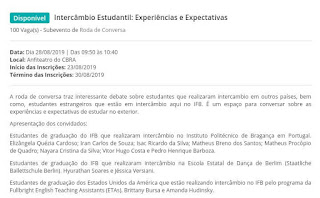
Presenting At ConectaIFB, Diplomatic Meeting, and EdUSA Fair
Such a big and tiring day. Amanda (my co-worker) and I met up with professor Fabricio at the metro station at 9 am, and because of traffic w...
-
 Such a big and tiring day. Amanda (my co-worker) and I met up with professor Fabricio at the metro station at 9 am, and because of traffic w...
 -
 Some things vary between the USA and Brasil, but nothing is as different as the Social Security number, called CPF in Brasil. In the USA, I...
 -
 The Science, Art, and Culture conference week takes up the last week of the fall semester at IFB. Students from all disciplines at our univ...